During my first engineering internship, I was tasked with developing an automation solution for a production line using a Japanese-inspired mechanical system known as Karakuri. The goal was to enhance operator ergonomics, improve convenience during packaging tasks, and reduce downtime caused by container changeovers. This project was a hands-on opportunity to apply my mechanical engineering knowledge in 3D modeling, material selection, system integration, and testing within a real-world manufacturing environment.


The primary objective was to design and implement a mechanical automation system that could support packaging operations across a variety of product types. To meet this target, I focused on:
Research & Analysis: I gathered data from over 16 production lines and analyzed more than 2,000 product variations to identify common design requirements based on size, family, and packaging formats.
Versatility & Ergonomics: The system needed to accommodate a broad range of product types while improving operator workflow and reducing unnecessary physical strain.
Downtime Reduction: A key deliverable was reducing downtime caused by manual container swaps, enabling more efficient use of production time.

I developed a solution-driven workflow that combined data analysis, engineering design, and iterative feedback:
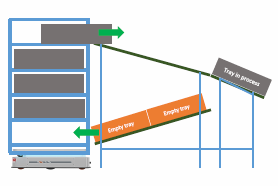
After 4 months of development and iterative review, the final design was approved and installed on the pilot production line. The system was fully operational within a month and demonstrated a measurable impact: it reduced downtime by 30 minutes per day, resulting in an estimated $400,000 in annual savings. The success of the pilot led to the decision to replicate the system across the entire facility. This project not only validated my technical skills but also taught me how data-driven design and effective communication can drive meaningful change in a high-stakes manufacturing environment.